Jousting is given the 21st Century roar of
approval at the Arizona Renaissance Festival (ARF).
On winter weekends in the Arizona desert,
Knights will again strap on the heavy suits of armor, settle
astride snorting chargers, take up their lances and tilt
with each other.
These Knights (actually stunt riders and
actors) are regular performers at more than a dozen
"Renaissance Villages" around the country and will be
battling at the Arizona Renaissance Festival.
They perform on a tournament field within
the Festival park in the foothills of the Superstition
Mountains just east of Apache Junction, Arizona.
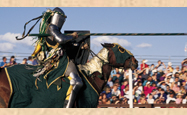
(Photo) Two tons of horse, knight and
armor gallop onto the field prepared to do battle with
ten-foot lances for a lady's honor at the Arizona
Renaissance Festival.
The origins of jousting are believed to be
in classical Rome, but the "sport" rose to its greatest
popularity in Europe by the 1400's. It all evolved from mock
battles in which knights on horseback, assisted by foot
soldiers, formed into teams and charged at each other in
some wide meadow.
The result was a "melee" (the word hasn't
changed in a millennium) of shattered lances, clanging
swords, flailing arms and legs - astride and afoot - that
went on all day and into the night. The earliest recorded
melee was in 1066 A.D., though mock combat had probably been
around for at least a century by then.
At first, the battles served more to hone fighting skills
than to provide popular diversion. But in peaceful times, a
knight needed a way to retain his skills. The Jousts were
great money-makers for the victors; instead of claiming mere
points, the winning team held the losers for ransom, often
accepting their horses and armor as payment.
 The many deaths which resulted from such "sport" let Popes
and English kings to ban jousting tournaments, though
English subjects often persisted and were repeatedly
excommunicated. The tournaments had become a featured
attraction at any kind of market faire or other significant
gathering. At the height of their popularity, jousts rivaled
a state fair, Super Bowl, rock concert and Octoberfest all
rolled into one.
The many deaths which resulted from such "sport" let Popes
and English kings to ban jousting tournaments, though
English subjects often persisted and were repeatedly
excommunicated. The tournaments had become a featured
attraction at any kind of market faire or other significant
gathering. At the height of their popularity, jousts rivaled
a state fair, Super Bowl, rock concert and Octoberfest all
rolled into one.
 By
the middle 1200's, the joust emerged as the favored way to
prove which of two (or more) knights was better. Most
contests were a "Joust a Plaisir" (for pleasure) in which a
winner was declared on the basis of points scored, though
some were still conducted "a l'Outrance" (to the death). In
the sporting version, the knights' swords were dulled and
their lances tipped with "coronals" (little crowns) to
prevent their penetrating a joint in the armor. Some
authorities believe that the lances were deliberately
weakened, a precaution still in effect today.
By
the middle 1200's, the joust emerged as the favored way to
prove which of two (or more) knights was better. Most
contests were a "Joust a Plaisir" (for pleasure) in which a
winner was declared on the basis of points scored, though
some were still conducted "a l'Outrance" (to the death). In
the sporting version, the knights' swords were dulled and
their lances tipped with "coronals" (little crowns) to
prevent their penetrating a joint in the armor. Some
authorities believe that the lances were deliberately
weakened, a precaution still in effect today.
Ring jousting
The training of a knight included spearing
a small ring, some on stanchions and some tossed in the air,
and quintain jousting. (Ring jousting is today the state
sport in Maryland.)
In quintain jousting, the knight tilted
with a mock opponent which sat on a revolving pedestal. If
he was inaccurate or too slow, the jouster might get whacked
by the sand bag on the other end of the contraption.
These quintain devices are thought to be
the precursors of Victorian carrousels. Many
turn-of-the-century carrousels had a variety of things to
grab, including a brass ring which entitled the bearer to a
free ride.
The joust became very civilized and formalized, though
severe injuries were common. According to the chronicler of
an English tournament in 1256, many of the noble contestants
"Never afterward recovered their health".
Jousting historical ban
England's King Edward lll put a temporary
public ban on jousting in 1370 but an intrepid troupe of
stunt riders and actors brought it back in the 1980's. Clad
in authentic looking breastplates and helmets, wielding
heavy lances, maces and blunted swords, they will thrill the
throngs at the Arizona Renaissance Festival.
 Some
fakery, as in professional wrestling, is to be expected.
Victor and vanquished are usually agreed to beforehand. As
in many Medieval tournaments, even the exact number of blows
is often settled.
Some
fakery, as in professional wrestling, is to be expected.
Victor and vanquished are usually agreed to beforehand. As
in many Medieval tournaments, even the exact number of blows
is often settled.
Modern re-creations of Renaissance era jousting tournaments
are depictions of historical events, coming from a time of
high ideals, noble causes and grand chivalry.
Photos and text courtesy of the Arizona
Renaissance Festival
© 2015-2020 Arizona Renaissance
Festival/EMOLorg/AZentertain,ecom. All rights reserved.