|
TECHNICAL STORY of "LOVE"
THE MUSIC
As Music Directors for LOVE, Sir George Martin and his son Giles Martin are at the epicenter of a revolution in the musical legacy of The Beatles.
The result is an unprecedented approach to the music for a stage
production. “After spending more than 40 years of my life working
with The Beatles and their wonderful music, I am thrilled to be working with it once again, on this exciting project with Cirque du Soleil,” said Sir George Martin, “The show will be a unique and magical experience.”
Using the techniques that Sir George Martin
pioneered in the sixties, linked to the best technology today, Sir
George and Giles have created a unique, groundbreaking soundscape of
original Beatles music for the show. Each listener will be
immersed in the world of The Beatles.
"One of the challenges of the job was
getting the balance of the songs right,” said Sir George Martin.
“We wanted to make sure there are enough good, solid hit songs in the
show, but we don't want it to be a catalog of ‘best of's’. We also
wanted to put in some interesting and not well-known Beatles music and
use fragments of songs."
The Martins have spent the last two years constructing the music for LOVE by combining every facet of The Beatles
recordings. The panoramic sound experience in the custom built
theatre will be the closest anyone will get to hearing the band play
live again and the closest anyone can get to actually being in the
studios with them.
"Our mission was to try and achieve the
same intimacy we get when listening to the master tapes at the studio,"
says Giles Martin. "The songs sound so alive. The last thing
we wanted to create was a retrospective or a tribute show. The Beatles, above all else, were a great rock band. A lot of people listen to The Beatles
in a conventional way (radio, MP3 player or car, for example) but never
in such a space. With the huge amount of speakers in the theatre,
I think we will achieve a real sense of drama with the music, the
audience will feel as though they are actually in the room with the
band. People are going to be knocked out by what they are hearing!
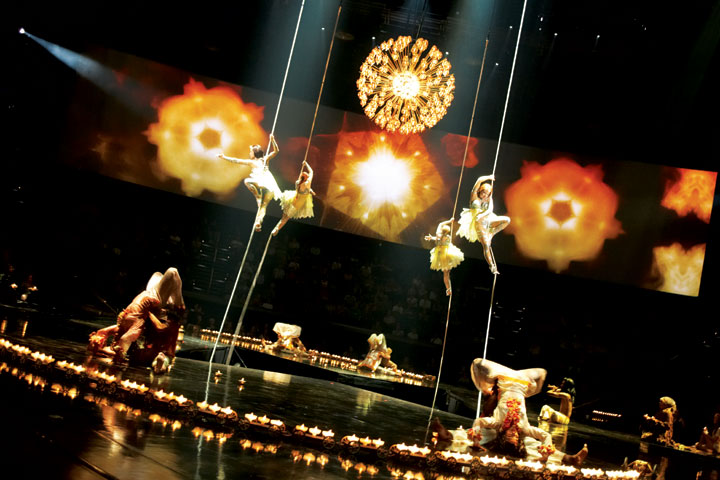
Photo: "Here Comes the Sun." Picture credit: Tomas Muscionico. Costume credit: Philippe Guillotel
THEATRE AND SET DESIGN
“There are only good seats, no bad ones, but you could come
and see LOVE three or four times and see something quite different each time.”
JEAN RABASSE, Set Designer
Acclaimed designer Jean Rabasse does not
distinguish between the interior of the theatre and the set design of
LOVE. In his view the two are so intertwined that it’s impossible to say
where the interior of the building ends and the décor begins.
The core concept of the design grew from
the idea of surrounding the Beatles in a “bubble.” Rabasse started with
the interior of the existing theatre and gutted the classical 1,500-seat
proscenium layout to place the action in the center, with 2,013 seats
surrounding the stage in a 360-degree configuration.
There are six entrance and exit points to the stage with four tracks to
carry the artists and four control booths, one at each corner of the
theatre.
One vital objective of the design was to
situate the audience in the intimacy of the experience by putting them
as close to the performers as possible, hence the furthest row from the
stage is only 98 feet from all the action. “I set myself the goal of
giving the audience the opportunity to connect with the performance at a
childlike emotional level through simple stage techniques and
transcendent music,” says Rabasse. In a sense, he was also recreating
the atmosphere and sensations of the big top—within a permanent
structure.
While the set elements are certainly
attractive to look at, few things on stage are there for purely
decorative purposes. Everything has a function. The greatest challenge
for Jean Rabasse was to allow for seamless transitions between scenes
with complex decors. For example, the show opens in the sky and then the
scene dissolves to the rooftops of London for the Beatles’ last concert
atop their building in Savile Row, and from there it travels to the
gritty ruins of wartime Liverpool.
The theatre has ten 12,000-lumen
projectors for each of the two huge 2,000-square-foot panoramic
screens, plus four 832-square-foot semi-transparent screens that are
moved by eight motors and served by four 16,000-lumen projectors.
While this is the most technologically
advanced theatre ever built, most of the technology is not on display
and therefore does not come between the audience and their enjoyment of
the show.
In addition to the visible elements there
is a highly sophisticated infrastructure at work behind the scenes and
above the auditorium. There are nine lifts and eight automated tracks
and trolleys that can simultaneously move 24 props, set elements or
performers, and they provide the production with 140 different ways to
put a performer into the air.
By integrating the lighting, projections,
acrobatic equipment and sound design into this environment, Rabasse has
created the ideal immersive space in which to present the music of
Beatles and the performances of the Cirque du Soleil artists. And for
Rabasse, the central and constant role of his design is the music, and
the way it sounds. “You can create true theatrical magic using simple
techniques, and when it’s integrated with the sound system that Jonathan
Deans has created for LOVE the result is an experience that is
completely immersive and totally involving,” he says.
COSTUMES
"I wanted to pay tribute to the creativity of the Beatles with my designs
and to accomplish that, I’ve tried to be as creative as they were.”
PHILIPPE GUILLOTEL, Costume Designer
For LOVE, Costume Designer Philippe
Guillotel set himself the tough challenge of evoking a sense of time and
place to fit the various eras of the Beatles’ career as a group. To
achieve that goal he has used Victorian and traditional designs
juxtaposed with fanciful, youthful, colorful fashions to reflect the
inventiveness of the Beatles’ visionary and revolutionary creative
energy in all its moods.
A team of experts has been working around
the clock to craft Guillotel’s 331 multi-layered costumes, using highly
textural fabrics and incorporating everyday materials such as foam,
plastic, industrial objects, inflatable inserts and lights. His designs
also called for the creation of custom-designed textiles, including
netting that fluidly takes on different shapes as the artists move on
stage.
“I don’t really have a signature style,”
says Philippe Guillotel. “But I don’t like to put in costume elements
that are merely decorative. I want things to work, to be functional. If I
include a button, it’s not there for show. It’s there because it has a
job to do. And although they have their uses, I don’t really like the
so-called ‘noble’ fabrics as much as more modest, everyday materials.”
Many of the LOVE costumes are exceptionally
large and highly crafted, almost like outsized puppets or mascots.
Some, as in the Mr. Kite scene, are imbued with fantasy and whimsy,
featuring concepts such as an oversized accordion or a fog effect
concealed within the costume (which exemplifies the significant
crossover between props and costumes on this show). For the Sgt. Pepper
Parade Guillotel took a fresh approach to the Savile Row tailoring
tradition by turning suits inside out to expose their colorful linings
and create a punchy, expressive visual statement.
The key characters in the show are directly
inspired by individuals mentioned by name in the Beatles’ songs, and
Guillotel has rendered their costumes in a stylized form that recalls a
comic-book graphic approach to the clothing worn in wartime Liverpool.
Her Majesty usually appears in a large, ornate picture frame. Mr. Piggy
and his inflatable costume represent the excesses of the establishment.
The character Julia (who represents motherhood) appears in a ball gown,
and in one of the most spectacular costumes in the show, as a jellyfish
“flying” through the Octopus’s Garden in the sea.
There is also a chorus of Groupies and
Lovers populating LOVE, and their costumes are informed by the 1960s and
1970s. But Guillotel is quick to point out these designs are
interpretations, not reproductions, of actual fashions of the time.
”That would have been the easy way to go,” he points out. “But it would
have been far less well suited to the intentions of the show.”
SOUND DESIGN
“With the Beatles’ music, the audience arrives forearmed with a
deep knowledge of the music and the sound has to meet and exceed their expectations.”
JONATHAN DEANS, Sound Designer
Jonathan Deans says the fact that LOVE is
based on the music of the Beatles posed a huge challenge above and
beyond the regular demands of designing the sound for any other Cirque
du Soleil show.
“The difference is that in other shows the
music is written specifically for the show, and it can be developed in
any way we like, to suit us,” he says. “The technology isn’t there to
impress, but to make sure the experience is moving. It doesn’t matter
that there are 12,000 speakers, what’s important is that each seat is
fitted with six speakers in order to hear the Beatles’ music like it’s
never been heard before.” To achieve that objective, Deans has assembled
and deployed an audiophile’s dream wish list of equipment.
There are eight sound system zones in the
theatre, each with dedicated Meyer M1D Stereo Line Arrays capable of
functioning independently of one another. Each zone provides the
listener with fully immersive 360-degree surround sound that can be
precisely placed one foot in front of the listener or up to 80 feet away
in most directions and moved in any direction.
LIGHTING DESIGN
“The challenge with lighting LOVE was to focus the spectators’
attention on one highlight or one artist specifically on this in-the-round stage.”
Yves Aucoin, Lighting Designer
Yves aimed to recreate the mood of the
1960s, with the lighting design he created for LOVE. He wished to
preserve the warmth, color and tones of that decade, from rock’n’roll to
psychedelic. He was very much inspired by album covers,
photographic news reports from the 1960s as well as the separation of
photos in different colors and the stretching of images, which are
trends that the Beatles themselves initiated with some of their album
covers.
Yves created a very distinct world for each
of the songs of LOVE. His biggest challenge was to work with a
360-degree stage, on which the front light shining on the action is
actually also the back light for half of the spectators.
The lighting style that characterizes Yves
can be identified through his use of new technologies such as automated
lights. His preferred color palette is a warm one, although the
feeling on stage usually guides his choice of colors. “I am
influenced by the music and the work of the Artists. I am usually
the last Creator to make final adjustments to my work during the
creation of a production.” says Yves.
PROJECTION
“LOVE evokes the world of the Beatles,
and therefore connects with the imagination of the audience. So I tried
to find ways to make the connection timeless, by recalling time-honored
techniques such as watercolor, which I used like a painter.”
FRANCIS LAPORTE, Video Projection Designer
Francis Laporte’s projections for LOVE
blur, bend and extend the definitions of theatre design. They evoke
time, place and mood through a picture-perfect succession of moving
images in a state of constant flux. Laporte’s work seamlessly integrates
digital video production and projection technology with the interior
structure of the theatre, the show’s lighting design and the more
traditional three-dimensional set elements featured in the production.
Above all, however, the projections must
work in perfect synch with the music and the actions of the artists as
they explore the journey of the characters inside the Beatles’ songs and
immerse the audience in the emotion of each scene. That is why Laporte
deliberately avoided a high-tech look. Instead, he opted for a fluid
mélange of shadows and silhouettes, archive footage, natural elements
and pigmentation, photographic collage design, time-honored
techniques such as watercolor and composite video images.
To reflect the different eras in the story
of the Beatles, the projections transform from sepia tones to
kaleidoscopic design, and from black and white images to a psychedelic
parade of color. To achieve all this, Francis Laporte combined the
latest technologies with a more established approach, using advanced
high-definition digital technology to reinterpret the graphic techniques
of the 60s.
Custom software directs the flow of
crystal-clear panoramic moving images projected onto 100-ft-wide
screens. A key element of the programming is the time-coded system that
ensures the projections’ programmed cues are synched up flawlessly with
the recorded music used in the show. The system can respond in real time
should that become necessary at any point during a show.
The real-time authoring system also gave
the show’s creators the ability to mix and change multiple layers of
images on the fly during rehearsals to create the exact mood and precise
effect they were seeking for each act.
Francis Laporte points out that the
projection system for LOVE is not only more elaborate than anything used
in a previous Cirque du Soleil show, it goes beyond anything ever
attempted in any permanent theatrical production in terms of its size,
power, complexity and capabilities. “At Cirque du Soleil, we have
the great good fortune of working in a context where everything isn't
seen in terms of constraints," he notes. “Instead, there's a shared
determination to see how far we can push the limits.”
PROPS
“LOVE is on many levels closer to theatre than to circus and the prop poetically
reveals and supports the development of the character as it evolves
throughout the show and the history of the Beatles.”
PATRICIA RUEL, Props Designer
There are close to 600 stage and acrobatic
props in LOVE, including luminescent umbrellas and two 32-ft-long
remotely manipulated trains adorned with flickering candles. The show
also features a multitude of musical instruments presented in unique
ways. From unusual drum kits and destroyed cellos, Beatles guitars
and triangles to fantasy instruments of pure whimsy. There’s even
a piano from which masses of bubbles erupt.
Designer Patricia Ruel says a prop is more
than a mere object or costume element, “A prop can play a decisive part
in defining a character and evoking a time or a place. It can also help
establish mood and atmosphere.”
The props in LOVE are a blend of antiques,
junkyard discoveries, off-the-shelf hardware and custom-designed
handcrafted pieces. One item can appear in many guises throughout the
show. A perfect example is her use of umbrellas. An umbrella
can be used to symbolize the broken wings of Blackbirds and in an
instant it is transformed into fish floating through the Octopus's
Garden only to reappear as psychedelic images in the universe of Mr.
Kite. Later in the show, umbrellas reveal swirls of red petals in
Hey Jude.
“A great deal of work has gone into the
creation of the characters,” Ruel notes, “Each of them owns objects that
help in that process.” Character development is reflected in the
evolution of certain props such as Eleanor Rigby's train of belongings.
Drawn from the lyrics of the song, Eleanor Rigby's story is carried with
her on a train lit by candles; each carriage represents a specific era
in her past. Charred and fragile from the war, the train grows
throughout the show as she collects memories.
Sgt. Pepper's story is reflected in his
collection of eclectic musical instruments. After his marching band is
destroyed in the war, he collects the debris of everyday items. Teapots
and pipes, pots and pans, whatever he manages to recover in the wreckage
of war, is assembled to become his instruments. These 'restored'
instruments are actually constructed of lightweight PVC and vacuform and
feature detailed patina work which gives them their antique, destroyed
appearance.
In addition to Ruel’s creations, renowned
puppet designer Michael Curry has assisted in the development of three
Volkswagen beetles: the smoking car, the rolling car and the crash car.
The crash car is constructed out of puppet components, which allows the
artists to break the car apart in choreographed movements. Curry also
developed a quirky device made from yellow rubber boots, and two
large-scale paper-puppets for the lyrical While My Guitar Gently Weeps
sequence.
Ownership of the trademarks: Apple
Corps Limited for The Beatles (word & design), ™ Cirque du Soleil
for Cirque du Soleil (word & design) ® and The Cirque Apple Creation
Partnership for LOVE (word & design). ™ Trademarks used under
license. © 2006 The Cirque Apple Creation Partnership.
© 2009-2013 EMOL.org Las Vegas Entertainment Magazine. Entertainment Magazine. All rights reserved.
|
