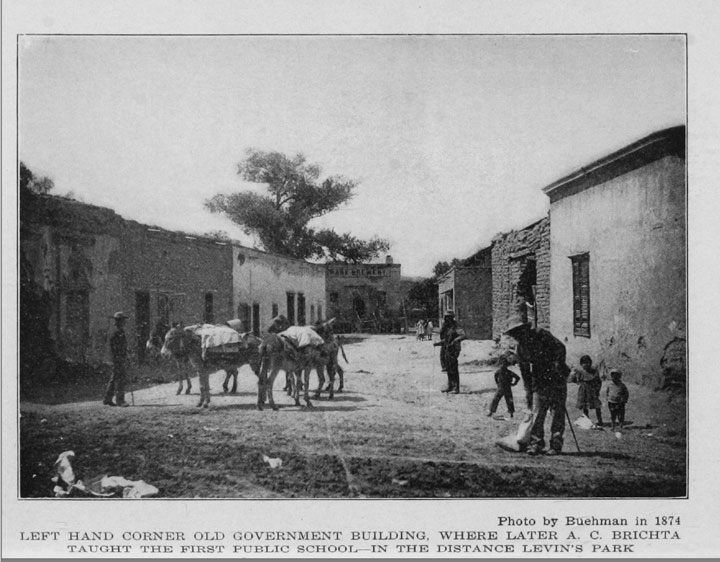
Because of its antiquity Tucson has had
in earlier years many points of interest, some of which continue unto
the present day. Besides the old San Xavier Mission already mentioned, there are the ruined walls on top of Tumamoc Hill, just west of town.
By whom or by what race the
fortifications were built is not known, but the lines of defense are
still plainly visible. Many large boulders with eastern face are covered
with hieroglyphics of a lost race, whose meaning still remains
unsolved.
For many miles north of the Pueblo, in
the Santa Cruz valley, lie scattered evidences of dead cities, with a
mile square of buried foundations There is also the abandoned government
post, old Fort Lowell, which was built and occupied by the military
force whose near presence on the Military Plaza in the village was not
deemed of longer necessity, though for reason of liable attacks, from
Indians to the number of many thousands on reservations still in the
terri- tory, it was not safe to dispense with their presence, within
immediate call.
Levin's Park is also worthy of some
description, having been for many years a very popular resort in Tucson.
Here the San Augustine fiestas were held, celebration of both American
and Mexican independence, and was the scene of many a revelry. It was
the constant care and pride of Alexander Levin, who set out the rows of
trees, and watched their growth from slender saplings to trees of great
height ana size.
The entire area of the park, about seven
acres, was shaded by their foliage. Benches and tables were provided
for the guests, and refreshments furnished from a restaurant on the
grounds. A high fence made it safe from improper intrusion, and a
gatekeeper held the premises in charge. A skating rink, shooting
gallery, bowling alley and dancing pavilion were prominent attractions.
Music was discoursed every evening by a first-class string band, and
concerts every Sunday afternoon were much frequented. Its pleasant shade
and cool breezes were blessings in this village on the Santa Cruz, and a
visit to Tucson was not considered complete without taking in the old
mission, Levin's Park and Fort Lowell, which as long as invested by the
military, divided honors with the park as a resort for the social set of
early timers.
The first public school in Tucson was
taught in the winter of 1868-1869, by Mr. Augustus Brichta, who quite
recently died. He came from Prescott, where he was assistant clerk of
the legislature, and in the absence of the chief clerk, says that he
convened the first assemblage of that body after its removal to Tucson.
After the opening of the Legis- lature he resigned his clerkship and
taught school for four months in an adobe building formerly occupied by
the government, on the little street leading to Levin's Garden or Park.
Mr. Brichtafound it difficult to obtain suitable books, notwithstanding
the Spanish-speaking boys learned rapidly to speak English, and became
quite proficient in the three R's.
The next public school was taught by
John Spring, on Meyer Street, in the vicinity of the old Palace Hotel.
Mr. Spring enrolled one hundred and thirty- eight boys, the majority of
whom were Spanish.
In 1870 St. Joseph's Convent Academy
started up with the arrival in Tucson of seven sisters, and this
institution, keeping pace with the general growth of the city in
forty-one years, will bear favorable comparison today with any similar
school on the Pacific Coast. All honor to those self-denying women, who,
casting aside the pleasures of the outer world, are devoting their
lives to the educational and moral ad- vancement of those committed to
their care.
In the summer of 1872, Mrs. L. C. Hughes
opened a school for girls, in a house in Levin's Park. This school was
well attended and proved very beneficial.
In 1873, Miss Harriet Bolton, afterward
the wife of Gen, John Wasson, and Miss Maria Wakefield, who became the
wife of our esteemed townsman, E. N. Fish, took charge of the school,
and were excellent teachers.
In the fall of 1874, Prof. W . B.
Horton, afterward Superintendent of Public Instruction, became
principal, with two assistants, Ignacio Bonillas and Miss Packard. Later
the lamented Willis B. Horton also conducted a post tradership on San
Carlos Reservation, and was brutally shot in front of his own store by
an Apache. However, swift vengeance overtook his slayer, for the Indian
scouts immediately gave chase, and shot the Apache, who died about the
same time as the man he murdered. Although suffering cruelly Mr. Horton
said to his associates with-in call, "I can't pull through boys— until I
have bid you all good-bye."
Mr. Horton was a personal friend of the
writer's family, and their eldest son, Willis, was named for him.
Demonstrating with him for accepting so dangerous a position, he
answered, That it was the safest place from Indians in the territory."
Succeeding teachers in early times were
Miss Nesmith and Mrs. Aquerre, whom we all knew and loved; Miss Nora
Smith and Miss Sallie W ood. By 1882 there were enrolled three hundred
and fifty pupils, with seven instructors, viz.: Professor Hall, Miss E.
J. Monk, now Mrs. Guild, who still teaches, Mrs. Martha White, Miss L.
A. Royce, Miss Lizzie Borton, Miss Sallie Wood. Instructor in music,
Miss Jessie Medbury, and teacher of Spanish, Chas. H. Tully.
In 1881-1882 the first kindergarten in
Tucson was established by Miss Estelle Morehouse, who taught the little
ones in the then unoccupied Presbyterian Church on Court Plaza, which is
now the Congrega- tional house of worship.
Thus we see that, even in that early
time— before streets were graded or lighted; when sidewalks went up hill
and down, nor even thought of being curbed, but furnished sleeping
quarters for the Mexican population in hot weather, pedestrians being
obliged to walk out into the street to avoid walking over somebody's boy
or girl; when we had to buy water by the bucketful, as we now buy milk
by the pint or quart, the water being brought from springs just north of
Carrillo's Gardens— there was a strong feeling in favor of educational
measures. That idea seems to lie at the foundation of American life and
institutions. Educate the rising generation, then we have men of nerve,
character, ability and standing to handle the stirring questions of
government, prob- lems of ways and means, and all the perplexing and
knotty questions of daily life and toil. Educate and train our girls to
think high, aim at lofty ideals, and fit themselves to be good home
keepers, domestic wives and helpmeets, and careful, intelligent mothers
of those intrusted to their care.
It has been said, and truthfully, that
the western pioneer builds, first a school house, and then a church, and
our little village was no exception. St. Augustine Church, first
established near the old cemetery on Alameda Street, and known as the
Church of the Presidio, was afterwards relocated in a small chapel near
the corner of Congress Street and Church Square. In 1866 the foundation
of the structure, now known as San Augustine Hotel, was laid and
completed for worship under Bishop Salpointe in 1869.
The old Presbyterian Church, located on
Meyer Street and Court Plaza, was begun in 1878 and completed in 1879,
Messrs. Fred Austin, W. W. Williams and W. C. Davis being trustees. Rev.
Mr. Anderson was the first pastor. The organization had previously met
for worship in the City Hall.
The Methodist Episcopal Church was
organized in October, 1879.Rev. W. G. Mills was the first pastor, and
services were held for some time in the old Court House. Their fine lot
on the corner of Pennington Street and Stone Avenue, was purchased in
1881, and church erected and dedicated the same year, with Rev. G. H.
Adams, Superintendent of Methodist Missions in Arizona, for permanent
pastor. Its cost was nearly $5,000, while the parsonage, now removed,
and lot occupied by Mr. Steinfeld, was built in 1882 at a cost of
$1,800.
The First Baptist Church of Tucson was
organized at the residence of Mr. E. S. Dodge, April 7th,1881, with six
members, besides the pastor, who was Rev. Uriah Gregory. Charles D.
Poston and Benjamin Goodrich were members of the board of trustees. In
May a lot was purchased for the church and parnonage, consisting of one
hundred feet on Stone Avenue and sixty-six feet on 8th,now called
Council Street. On May 15th, recognition services were held in the
Presbyterian Church. Rev. J. W . Osborn of Nebraska preached before the
council at 11 a. m., and Dr. O. C. Wheeler, Moderator, made the evening
address, and three new members were added by letter. The new chapel was
dedicated in January, 1882.
The First Congregational Church of
Tucson was formally organized on November 20th, 1881. The services of
recognition, by courtesy of the M . E. Church, were held in their house
of worship, under the direction of Revs. L. H. Cobb, D. D., of New York,
and J.H. Warren, D.D., of San Francisco. There were nine original
constituent members. The Rev. L. B. Tenny, of New Hampshire, was acting
pastor for the summer of 1882,but in December of the same year, the Rev.
C. B. Sumner, of Massa- chusetts, became regular pastor. Arrangements
were at once made, and money pledged for the purchase of the church on
Meyer Street and Court Plaza, formerly built by the Presbyterian
Society, that church having dissolved its organization, though in later
years it reorganized and is at the present time one of the most
prosperous churches in modern Tucson.
The Congregational Church was for a
number of years a Home Missionary Church, as indeed were all the others
in those pioneer days—that society aiding the church to the extent of
$3,000 on its purchase price of $5,000. All of Tucson's churches are, at
the present time, self supporting.
Grace Mission Episcopal Church was
organized September 1st, 1882. Services were at first held in the
Probate Courtroomin the new CourtHouse. In connection with the mission
there was a guild for religious and charitable purposes. Pres., Mrs.
Grace Manlove; vice-pres., Mrs. Adelaide James; treasurer, Mrs. Sallie
A. Buell; secretary, Rev. C. J. Hendly, B. D.
In 1871 the citizens of Tucson organized
a village government, with Major S. R. De Long as mayor; councilmen,
Samuel Hughes, W. W. Williams and W. S. Oury; treasurer, Hon. Hiram
Stevens; recorder and assessor, W. J. Osborn. During that year inquiry
was made by the council relative to a congressional donation in 1864 of
land for a townsite, when it was learned that though such donation had
been made, yet it had lapsed through failure of Tucson to make it
available.
In 1872 the same gentlemen served in
town offices, except that E. N. Fish was treasurer, and in this year the
sum of $1,600 was paid the government for United States patent to two
sections of land for the townsite of Tucson, and in August of the same
year, the village authorities began to issue deeds to purchasers of
lots, and to donate land for school and church purposes. In 1873 the
same gentlemen vserved as town officers, and in 1874 the same, except R.
N. Leatherwood took the place of C. T. Etchells. In 1875 the mayor was
Estevan Ochoa; councilmen, P. Drachman, C. T. Etchells, Samuel Hughes
and R. N. Leatherwood; treasurer, E. N. Fish; recorder, C. H. Meyer. In
this year the salary of marshal was fixed at $20, but could be increased
in special seasons. Artesian wells were also projected and contract
awarded, but it was found that artesian water didn't materialize so
readily. Also in this year the village purchased a wagon, harness and
two good mules for town use, but later sold them as being too expensive
to operate.
The old cemetery was abandoned this year
as a place of burial, and ten lots were donated by the village for a
new one, also lots for a Catholic cemetery. Village lots were offered
free to all persons im- proving same to the extent of $100, and residing
thereon for six months. Hospitalities of the village tendered to Gen.
A. W. Kautz and staff this year.In 1876, mayor, J. B. Allen; councilmen,
Samuel Hughes, R. N. Leatherwood, C. T. Etchells, P. Drachman;
traasurer, E. N. Fish; recorder, C. H. Meyer. This must have been a hard
year for the Old Pueblo for a petition was presented to the council
asking that an election should be held to get the sense of the community
as to whether the village should disincorporate and merge again in the
county organization. At such election the people decided in the
negative. Board of Trade (note the improvement) was permitted to erect a
powder magazine at a safe distance from town. The place selected was
just off what is now North Main Street, but in later years it blew
itself up and nothing was ever seen of the powder magazine again except a
big hole in the ground.
Hospitalities of the village tendered to
the Mexican general, Mariscal, and staff. The planting of trees along
the streets was officially encouraged, but nothing accomplished in that
line, for though Tucson had soil and sunshine, it takes both work and
water to make things grow.
Gen. Phineas Banning conferred with the
mayor and common council concerning the right-of-way and depot grounds
for the Southern Pacific Railroad, which was in process of construction
somewhere.
In 1877, J. B. Allen, mayor; councilmen,
R. N. Leatherwood, Samuel Hughes, Isaac E. Brokaw and A. G. Buttner;
treasurer, E. N. Fish; recorder, Joseph Neugass; with a Board of Health
as well as a Board of Trade.
A new charter for incorporating as a
city was drawn and granted by the Legislature, and with the council
meeting of February 7th, 1877, Tucson ceased to be a village, and
henceforth assumed the duties and responsibilities of municipal
existence. At the first city election in 1878 Col. James H. Toole again
became mayor; councilmen, R. N. Leatherwood, Paul Abadie, C. R. Drake
and P. Drachman; treasurer, W. W. Williams; recorder and police justice,
W. S. Edwards. Total debt of the city, January 8th, $1,188.
Municipal election of 1879— mayor, Jas.
H. Toole; councilmen, Chas. R. Drake, Alexander Levin, R. N.
Leatherwood, P. Abadie; treasurer, W. W. Williams; recorder, W. J.
Osborn. On May 6th Mayor Toole tendered his resignation, which was
unanimously not accepted by the council.
By this time railroad matters had made
commendable progress, and at a special election held on June 21st, the
citizens voted solidly that bonds to the amount of $10,000, should be
issued by the city for the Southern Pacific depot and grounds,
right-of-way, etc., and it was done as ordered. Rights and privileges
for feast of San Augustine sold by the city for $600, but thereafter
were not allowed within the city limits, but annually resort to San
Xavier for their festival.
In 1880, a very important year for
Tucson, R. N. Leatherwood, mayor; councilmen, M. G. Samaniego, C. T.
Etchels, Alexander Levin and C. R. Drake; re- corder, C. H. Meyer;
treasurer, P. R. Tully, surveyor, G. J. Roskruge.
On March 10th a celebration of the
connection of the eastern and western lines of the Southern Pacific in
Tucson took place with a banquet, and the grand- est display the little
city had ever witnessed. More than a hundred citizens acted on
committees; many eloquent speeches and addresses were made, and general
good feeling prevailed. Many telegrams had been sent concerning the
affair, and congratulations in reply were read, one of which was of
special interest, purporting to have come from the Pope, who sent
cordial congratulations, but inquired whether Tucson were not in the
other world.
In this year railroad bonds 1, 2, 3 and
4, amounting to $2,000, were paid up, while in 1881 the balance of the
bonds, amounting to $8,000, were cancelled by the city fathers, which
speaks well for the little city. At this time the city property,
consisting of forty-five blocks and parcels of unsold land, was valued
at $25,000,and the authorities had in contemplation the building of a
commodious City Hall, which should house the entire municipal
government.
In 1884, the Arctic Ice Company, owned
by ex- Surveyor General Royal A. Johnson & Co., bought out two local
concerns, manufactured, and for many years supplied the city with this
cooling necessity.
The Territorial University, established
by an Act of the Thirteenth Legislative Assembly, of 1885, at Phoenix,
completed and opened for students in October, 1891, belongs rather and
fully to new and greater Tucson, yet its beginnings were in a period of
great transition for the Old Pueblo. The bill was introduced into the
council by Hon. C. C. Stephens, car- ried through the house by the able
efforts of Hon. S. M. Franklin, of our city, and approved by Governor F.
A. Tritle, March 12th of that same year. Third Street, now the handsome
boulevard, electric line and driveway to the University, was then still
in the brush, and was only thought of by the inhabitants of Buell's
addition, in that vicinity, as the winding trail to the gruesome
graveyard, northwest of town.
Students and their friends, first going
out to the University, went by several cut-offs, across by the old
depot, striking 9th Street at several different angles, and if by
vehicle, were in danger of being found standing in the arroya, with the
cart before the horse, by reason of the steep hills and deep gullies.
Had automobiles been in fashion then, they would have jumped from one
hill to another, or turned turtle at the bottom.
Tucson, in early days was honored with
many dis- tinguished guests, United States senators, ambassa- dors to
foreign countries, barons and baronesses, so-called, earthquakes and
even presidents of the United States. In March, 1880, President Hayes
arrived, and was entertained with much enthusiasm. The presidential
party and invited guests dined at the residence of Mr. and Mrs. W.W.
Williams. In later years President Harrison also passed through Tucson,
and held an informal reception for the business men of the city from the
platform of his private Pullman.
Senator J. J. Ingalls, in one of his
published letters concerning his visit to Tucson wrote: "I regret that I
did not come earlier. It is said to be hotter than a crematory in
summer, but the winter weather is cer- tainly incomparable—if what I
have experienced so far is a sample. The dryness, the stillness, the
brightness, the inexplicable charm of mountain, plain and sky; the hues
of sunset and dawn, the splendor of the stars, the vague, blue mystery
of the horizon; the odd, quaint town, with its queer people and their
habits; its gambling dens open on the main streets, day and night; its
cowboys and miners and tramps and toughs and gentlemen, all make a scene
of indescribable interest and enchantment; Mexicans, Indi- ans,
negroes, Chinamen and Americans, with half a dozen different languages
and lingoes, make up the constantly changing population, that, for all
its vices and immoralities, is as quiet and orderly as any Kansas
hamlet."
Hon. Whitelaw Reid in the New York
Tribune, says, concerning the air of Arizona: "The atmosphere is
singularly clear, tonic and dry. I have never seen it clearer anywhere
in the world. It seems to have about the same bracing and exhilarating
qualities as the air of the great Sahara in Northern Africa, or of the
desert about Mount Sinai in Arabia. It is much drier than any part of
the valley of the Nile north of Cataract."
The baron and baroness mentioned were J.
A. Peralta Reavis and his wife, who in those days traveled in great
state, for they had back of them capi- tal furnished by men of great
wealth, Robt. G. Inger- soll, Roscoe Conkling, Collis P. Huntington,
John W. Mackay, Chas. Crocker and many others.
Reavis planned, and barely failed of
success, in perpetrating one of the most gigantic frauds against the
United States government that was ever conceived. The government paid
over $100,000 in de- fense. Reavis was convicted of conspiracy to
defraud the government, his scheme was exploded, and his sentence was
two years in the penitentiary of New Mexico. His object was to establish
right to a vast grant of land, through inheritance of his orphan
girl-wife, from an extinct family of Spanish nobility. They came to
Tucson to have certain documents photographed, and to prove title, and
probably to see the land—which was situated on the Gila river—
consisting of 12,500,000 acres, computed at $100,- 000,000. Its western
border rested upon the eastern line of the Pima reservation. When coming
to Tucson they would send word ahead to reserve the entire upper part
of old San Xavier Hotel for the use of themselves and retinue. Though
Reavis was a villain, and his wife no better, yet it is the lot of the
historian to chronicle the bad as well as the good.
On May 3rd, 1887, the year following the
close of our Indian troubles, Tucson experienced her first and last
earthquake of any moment, for Arizona has not been within the memory of
men living, or of any known history, one of seismic misfortunes. That at
some remote period it was the very center and outcome— as now
presented— of great internal convulsions, the whole aspect of the
country demonstrates, but it would seem on this one occasion that
Tucson, as usual, trying to be a little ahead of her neighbors, sprung a
surprise even on her own residents; for though the vibration lasted
only three seconds, yet during that time houses rocked, walls— even that
of the Congregational Church— were cracked, and many thought the end of
the world had come. Hanging lamps swung violently, boxes were jarred
off of shelves in closets, and dishes from shelves in stores. People who
got out of doors, and looked around them saw the track of the quake as
it went over the Catalina Mountains, leaving a cloud of dust that many
imagined was steam from boiling volcanoes. No one was hurt, and very
little damage rendered, but it opened the hearts of our citizens to the
sufferings of afflicted San Francisco when news flashed around the world
of her terrible misfortune by earthquake in 1906, for they made a
donation of $5,024, and Governor Pardee of California wrote an
appreciative letter of thanks to Mr. L. M. Jacobs, through whose hands
the gift passed.
From 1875 to 1895, various and numerous
franchises were granted for artesian water, plain water, gas and gas
lighting, electric lights, street railways, street grades, and improved
sidewalks. Also for naming streets in extended districts, numbering
houses, and telephone service. Even in 1905 a franchise to build,
maintain, and operate street railways, on cer- tain streets, was granted
to three different parties- all necessary and well meant improvements,
showing how the best and highest were reached out for, some of which
were accomplished, yet some expiring by limitation, crowned with
disappointment many efforts. Y et like the ever rising tide, each effort
ap proached more nearly to success, for from the Tucson Post of March,
1906, edited by Mr. Herbert Brown, we extract the following: "The noisy
clanging wagon, distributing steel rails along Stone Avenue, caused many
smiles of intense satisfaction on the faces of our citizens, for they
feel it to be an- other step in the evolution of our city." And surely
it was a prophecy of things to come, sewerage being extended the same
year.
The Tucson Citizen of same date
announces, "That women will be allowed to vote at school elections,
provided they are parents, or guardians, of a child of school age,
residing in the district, or if they have paid a territorial or county
school tax." This is evidence of two noble traits among our men: one,
that they recognize the mental status of women; and the other, that they
place a premium on motherhood.
During these years P. R. Tully served a
term as mayor, and a water franchise was granted R. N.Leatherwood, who
sold his right to Parker & Watts, Jos. R. W atts, manager, and they
erected water works, piping filtered water— first from the Santa Cruz
above town—then digging wells in the bed of the river, thus supplying
the city with as good, cold water as could be found anywhere, and as the
city grew, more wells were dug. Also Chas. M. Strauss served as mayor,
and with his councilmen, whose names cannot be learned, created valuable
regula- tions and ordinances relating to Fire Department and Police
Force, and the division of the city into Wards Nos. 1 and 2.
W. E. Stevens and F. Maish also served
as mayors, the latter of whom inaugurated the curfew— relating to
children being on the street after 8 p. m.— and granting franchise to
the Western Union Telegraph Company, and enacting ordinance looking to
the employment of vagrants for street work.
In 1893-1894 W. I. Perry was mayor; T.
A. Judd, recorder. Mr. Perry's administration was characterized by great
economy, for when it closed the city was out of debt and there was
money in the treas- ury. Thus the city government ran along, picking up
lines here and there, yet still with most of the streets ungraded,
which, with lack of capital, was probably responsible for failure of
street car franchises, and the sidewalks were neither graded nor curbed.
From 1895 to 1899 Henry Buehman, mayor;
Chas. T. Connell, recorder, we find the following ordinance enacted, and
carried out in spirit and letter, by his very capable corps of
councilmen, consisting of Frank Russell, Chas. F. Schumacher, General
Wilson, L. D. Chilson, Chas. Burkhalter, Messrs. Whalley and Miltenburg:
"Be it enacted by the mayor and common council, that the street
commission are hereby authorized and empowered to establish the width,
fix the grade, and prescribe the width of the sidewalks, of the whole,
or any portion of the streets, and alleys, and to order the whole, or
any portion, to be graded, paved, graveled or macadamized, in such
manner, and with such materials as the public good and convenience may
require." Also the fighting of fowls and animals was prohibited and
Congress Street extended to the westward. Likewise, ordinances passed
relating to the widening of Congress Street by the removal of the wedge,
the purchase by the city of water works and sewerage mains, the latter
of which was ably carried out in the succeeding administration, under
Mr. Gust. A. Hoff, whose councilmen warmly seconded his efforts in that
and other meas- ures for the public welfare. The removal of the "wedge"
was a big consideration, and though auspiciously for the city, was
finally accomplished, yet required the earnest and energetic work of
several administrations, among whom were C. F. Schumacher and Gen. L. H.
Manning, all of which is in the mem- ory of present city residents.
But we can hardly close this little
history of the Pueblo without a sympathetic glaIice at the old mule car
street railway system, with its plodding motive power—not at all
responsible for its grizzled appear- ance, yet was a big step in
transportation facilities for the social set of Tucson, though seldom
that it could be caught for the return trip, as darkness often settled
before it made an appearance.
The University boys from town, though
able to reach the scene of their daily toil on foot in advance of the
car, yet, unless too late to make the cadet drill at 8 a. in., generally
preferred to "take the car," in order to chat with the U. of A. girls,
going out at an early hour for the class in domestic science. When, by
reason of the jeers cast at them—for even mules are not so unfeeling as
one might think—they lost their equanimity, and ran the car off the
track, the fun loving, yet good hearted boys would jump off, and putting
their shoulder to the wheels, lift the car, girls and all, back onto
the track, then cheer the mules on, as sort of an apology, and to make
up for lost time.
This street railway system was one,
also, of accommodation, for the patronage being slow, to match the
mules, if the conductor saw across the plaza, a Prospective passenger
frantically waving her hands, the kind hearted man would wait a full ten
minutes, and perhaps lose several passengers from other directions, who
being in a hurry, couldn't await the starting up of the car, and
proceeded on their ways by biped trail. Sometimes in coming from the
University on foot, and trying to cut off space, one would lose his way,
and find himself standing in the arroya, under the Stone Avenue bridge;
but why mock at the mules, even though they were the city's joke, and
the humiliation of the burros, standing on the street corners, already
ashamed of their old fathers and mothers?
Now that we have installed the modern
electric trolley line, which goes whizzing by, making one almost imagine
himself in New York or San Francisco, we should not forget the humble
way by which we climbed to the present accomplishment.
Now that our citizens are preparing the
way for great railroad enterprises which will materially increase our
population, it seems that the next improvements from a monetary
standpoint would be invest-ment of capital, in the hands of big
companies or moneyed syndicates capable of handling large projects, like
raising artesian water, or water that does not necessarily lie so deep,
yet is below the surface, awaiting only the action of vast machinery to
make it the principal factor in the development of Arizona's abundant
resources. There is no doubt but that mighty subterranean rivers, that
once blessed this land in upper flow, still exist, sunken in beds of
sand, like the Santa Cruz, or stratified rock, like the huge bulk more
than a thousand feet below the surface at Tombstone, in Cochise County,
that seems to have quenched a mighty mining enterprise.Canalsor water
tunnels, costing perhaps millions of dollars, tapping the surface and
rocky caverns, possibly a hundred miles away, might lead that water to
the irrigation of millions of acres, in its onward sweep to the sea.
Then similar companies to build fine
roads, and trolley lines to the top of our loftiest mountains, there to
erect summer hotels and also to build and own hotels in the city, so
that whatever the change of season or temperature, the same builders
would always be sure of patronage to cover their heavy investments.
" 'Tis silent effort moves the world, Not noise, nor show, nor strife."
ADIOS!
These pages on Tucson history are from the book "Old Tucson; a hop, skip and jump" by Estelle M. Buehman available on Amazon.
Local Tucson Books
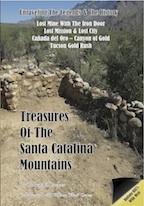 "Treasures of the Santa Catalina Mountains,"
by Robert Zucker. The legends and history of the Catalinas– the Tucson
Gold Rush, the Iron Door Mine, Buffalo Bill's mining camp, and the story
of mining the mountains for gold, silver and copper. Read chapters
online, download a free sample PDF of the book and purchase on
Amazon. "Treasures of the Santa Catalina Mountains,"
by Robert Zucker. The legends and history of the Catalinas– the Tucson
Gold Rush, the Iron Door Mine, Buffalo Bill's mining camp, and the story
of mining the mountains for gold, silver and copper. Read chapters
online, download a free sample PDF of the book and purchase on
Amazon. |
 "Entertaining Tucson Across the Decades,"
by Robert Zucker. Covers the local music and entertainment scene from
the 1950s through the end of the 20th Century. Interviews with local
musicians, original photographs and stories published in local
newspapers. Read chapters online, download a free sample PDF of the book
and purchase on Amazon. "Entertaining Tucson Across the Decades,"
by Robert Zucker. Covers the local music and entertainment scene from
the 1950s through the end of the 20th Century. Interviews with local
musicians, original photographs and stories published in local
newspapers. Read chapters online, download a free sample PDF of the book
and purchase on Amazon. |
© 2010-2019. EMOL.org. All rights reserved